Open Tuesday to Friday, 8:00 AM to 5:00 PM
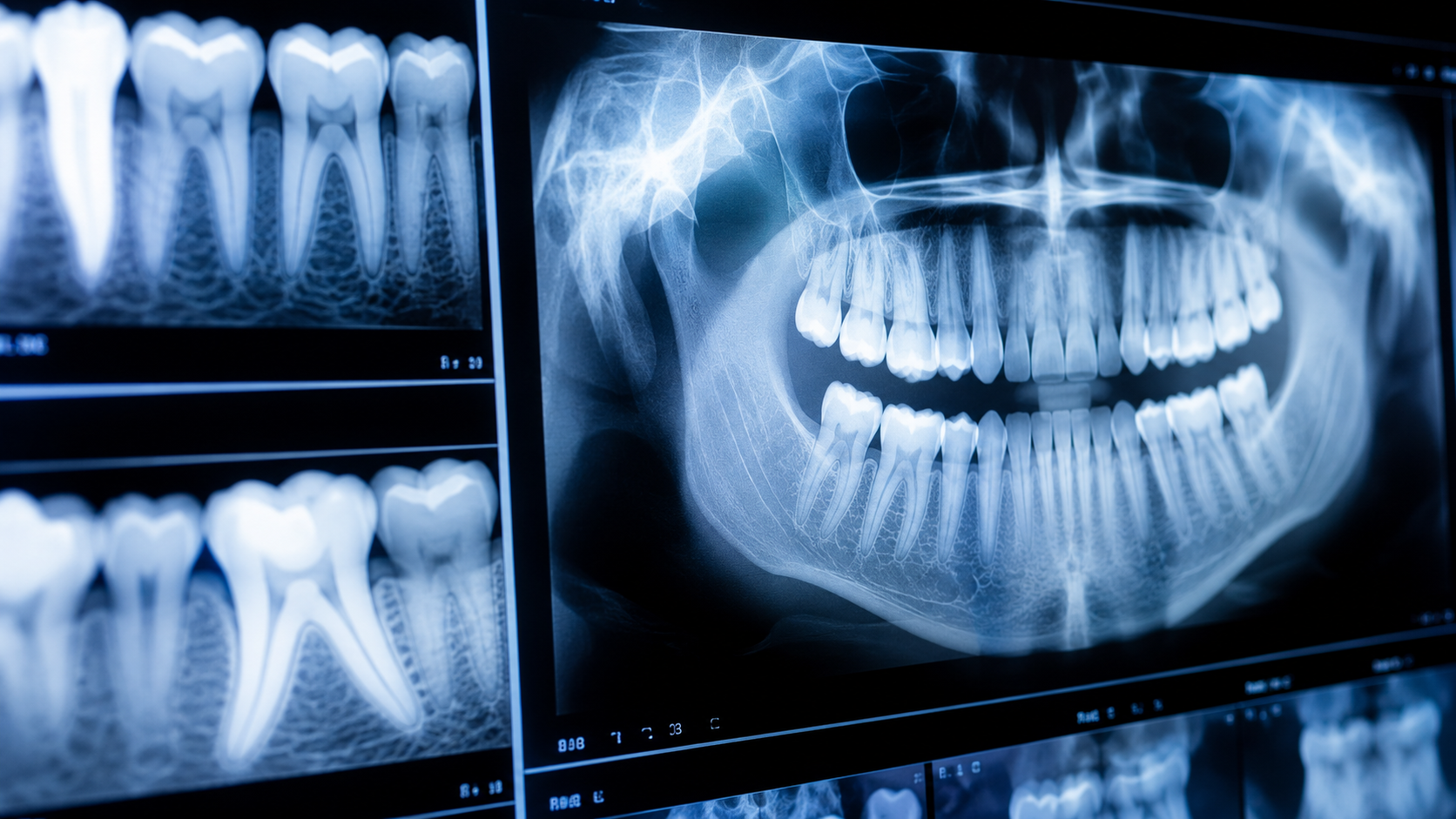
Dental x-rays let Dr. Matthew Collins see what a visual exam can't, like decay between teeth, infections under the gum line, bone loss, and problems hiding under existing fillings. Our digital x-rays capture clear images instantly with up to 90% less radiation than older film x-rays. Safer, faster, and more precise diagnostics in every visit.
 Up to 90% less radiation
Different dental issues need different views. Dr. Collins recommends the type of x-ray that gives us the clearest picture without taking more images than necessary. Most imaging happens right alongside your routine dental exam as part of our family dentistry care.
Show the upper and lower teeth in one view. Bitewings are the standard image for catching cavities between teeth and checking the fit of fillings, crowns, and other restorative dentistry work.
Typically taken once a year during a routine checkup.
Show one or two specific teeth from crown to root. Periapicals help diagnose abscesses, cracked roots, infections, and bone loss around individual teeth.
Often taken when a patient has pain in a specific area, like a toothache, or when planning restorative treatment.
Capture the entire mouth, jaw, and sinuses in a single image. Panoramic x-rays help us evaluate wisdom teeth, jaw joints, and bone structure.
Often used to plan dental implants, extractions, and orthodontic care.
Produce three-dimensional images of teeth, bone, and soft tissue. CBCT scans are referred for complex implant placement, severe infections, or detailed jaw evaluation.
Reserved for situations where standard x-rays don't provide enough detail.
Most dental issues start where your toothbrush, floss, and even a careful visual exam can't reach. X-rays catch them early, when treatment is simpler and less expensive, which is the whole point of steady preventive care.
Decay hiding in tight spaces where tooth surfaces touch each other.
Abscesses or infections at the root of a tooth that aren't visible to the eye.
Early signs of gum disease and bone deterioration around teeth.
Hairline cracks and damage that haven't surfaced yet.
Decay or problems forming under fillings, crowns, or bridges.
Wisdom teeth or other teeth stuck below the gum line.
Rare but important findings caught early through routine imaging.
One of the most common questions we get is whether dental x-rays are safe. The short answer is yes. Digital x-ray technology has cut radiation exposure to a tiny fraction of what older film x-rays delivered, and we follow strict ALARA principles (As Low As Reasonably Achievable) to keep exposure minimal.
Less radiation than film x-rays
Per bitewing x-ray
Equivalent natural background radiation
Always available for added protection
We never take x-rays just because. Dr. Collins recommends the right frequency based on your age, history of decay, and gum health, and kids' imaging through our kids dentistry care is timed even more conservatively. Here's what most patients can expect.
A full set of x-rays at your new patient visit gives us a complete baseline of your oral health. Existing x-rays from another dentist can sometimes be transferred to avoid retakes.
Bitewings every 12 to 18 months and a panoramic x-ray every 3 to 5 years is typical for adults with no active decay or gum disease. Less imaging means less exposure.
Patients with active decay, gum disease, dry mouth, or extensive dental work may need more frequent x-rays to monitor changes and catch issues early. Your schedule is always individualized.
Two Rivers Dental Group sees patients from Springfield and the surrounding Lane County communities. Our office at 1717 Centennial Blvd, Suite #3 is open Tuesday through Friday, 8:00 AM to 5:00 PM. Call 541-287-7874 to schedule your next visit.
Yes. Modern digital dental x-rays use up to 90% less radiation than older film x-rays, and a bitewing delivers about 0.005 mSv, roughly what you absorb from natural background radiation in two to three days. We follow ALARA principles and only take images that guide your care.
It depends on your oral health. Adults with healthy teeth and gums typically need bitewings every 12 to 18 months and a panoramic image every 3 to 5 years. Patients with active decay or gum disease may need dental x-rays more often. Dr. Collins builds your schedule around your history, never a fixed routine.
Tell our team if you are or might be pregnant. We typically postpone routine x-rays until after delivery and use added shielding whenever imaging is needed for an urgent problem. Your comfort and safety always come first.
Often, yes. Recent x-rays can usually be transferred to our Springfield office so you avoid retakes. Ask your previous practice to send them before your first visit, and we'll only take new images where your records have gaps.
Modern digital dental x-rays at our Springfield office, taken only when they help your care. Book online or give us a call.
541-287-7874