Open Tuesday to Friday, 8:00 AM to 5:00 PM
Dental sealants are one of the simplest and most effective ways to prevent cavities in kids. A thin protective coating goes on the chewing surface of the back molars, sealing out the food particles and bacteria that cause decay. The application takes about a minute per tooth. No drilling, no shots, no discomfort. Dr. Matthew Collins applies sealants when permanent molars erupt, usually around ages 6 and 12.
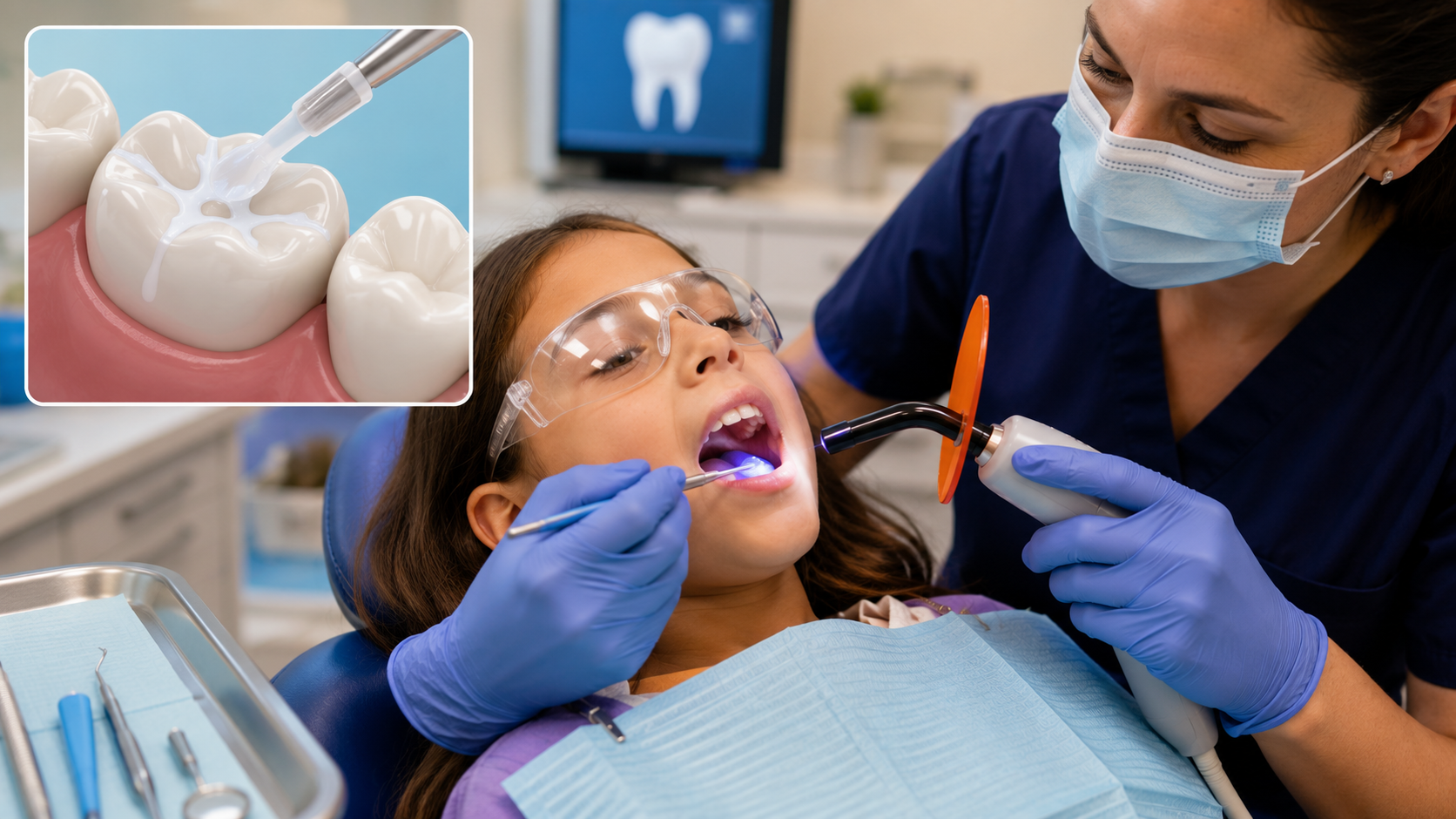
A thin, tooth-colored resin coating painted onto the chewing surface of a tooth. The resin hardens under a curing light and fills the deep grooves where food gets trapped.
The chewing surfaces of permanent back molars only. We don't seal front teeth or baby teeth in most cases. Molars are sealed because their grooves trap food.
Kids' new permanent molars have deep grooves that brushes can't fully clean. Sealants smooth those grooves out so food can't get stuck and cause cavities. They pair well with fluoride treatments for full prevention coverage.
Sealants protect the permanent molars that are most cavity-prone. Here's when each one comes in and why each one needs protection.
The "six-year molars" come in behind the baby teeth without any baby teeth falling out first. Many parents don't realize they're permanent. They're the most important teeth to seal.
The "twelve-year molars" come in behind the first molars during the tween years. Their grooves are even deeper than the first molars, making them prime candidates for sealing.
The teeth between the canines and molars. We seal these only when they have visible deep grooves that put them at higher cavity risk. Not every child needs them sealed.
For kids who are at high cavity risk, we sometimes seal back baby molars to buy time until the permanent ones come in. We make this call based on each child's specific cavity history.
Sealant application is fast, painless, and one of the easiest visits in the dental office. Here's exactly what happens.
The tooth is cleaned and polished to remove any plaque or food. This makes sure the sealant bonds properly to the enamel.
A gentle etching gel is brushed on for a few seconds to create a slightly rough surface. The tooth is then rinsed and dried.
The liquid sealant is painted onto the chewing surface, settling into the grooves. A small blue light hardens it in about 20 seconds.
Dr. Collins checks that the sealant doesn't interfere with the bite. Any small adjustments are made and your child is done.
A side-by-side look at what changes when a child's molars are sealed versus left unprotected. The numbers below come from the CDC.
Sealants are one of the few preventive treatments where the cost-benefit equation is genuinely lopsided in your favor. Here's why.
Sealants are one of the most affordable treatments in dentistry. Many insurance plans cover them in full for kids, and even without insurance the out-of-pocket cost is far less than a single filling. See our patient resources page for insurance details.
One sealant prevents the need for a dental filling, which prevents the eventual need for a dental crown, which prevents the eventual need for a root canal or replacement. The savings compound over decades.
Once a tooth has a filling, it's no longer fully natural. Sealants keep the tooth structure intact. A sealed tooth at 12 can still be a fully natural tooth at 50 if it never needs further work.
Two Rivers Dental Group applies sealants for families from Springfield and the surrounding Lane County communities. Sealants are usually placed during routine kids' dental cleanings as part of our kids dentistry care, and they work alongside the checkup habits covered in our preventive dental care. Our office at 1717 Centennial Blvd, Suite #3 is open Tuesday through Friday, 8:00 AM to 5:00 PM. Call 541-287-7874 to schedule your child's next visit.
The two big windows are around age 6, when the first permanent molars erupt, and around age 12, when the second molars come in. Applying dental sealants to each set soon after eruption gives the deep grooves protection before decay has a chance to start.
Not at all. There's no drilling, no shots, and no removal of tooth structure. The tooth is cleaned, a gel preps the surface, the sealant is painted on, and a small blue light hardens it. Each tooth takes about 60 to 90 seconds.
According to the CDC, sealants prevent 80% of cavities in the first two years after they go on, and keep protecting against 50% of cavities for up to four years. The CDC also reports that children aged 6 to 11 without sealants get almost three times more cavities in their first molars than children with them. Protection is strongest early, which is why we seal molars soon after they erupt and check the sealants at every cleaning.
The material itself typically stays on 5 to 10 years with normal wear, though the strongest cavity protection comes in the first few years. That's why we check dental sealants at every routine cleaning at our Springfield office. If one chips or wears down, it can be reapplied quickly at that same visit to restore the protection.
Yes. The American Dental Association recognizes sealants as safe and effective for children. Any trace material exposure from a sealant is minimal, far below what kids encounter from everyday sources, and the cavity protection benefit is well documented.
Schedule a sealant appointment at our Springfield office. Quick, painless, and one of the smartest preventive moves in dentistry.
541-287-7874